The Garmin Forerunner 165 and the Garmin Forerunner 255 sit closer together in price than their spec sheets suggest, yet they answer two different running questions. One is built around a bright AMOLED display and approachable training feedback; the other is built around endurance, multi-band positioning and a deeper recovery toolkit. This guide compares them as a purchasing decision rather than a feature dump, so the trade-offs that actually change daily use are the ones given room here. Both sit inside the Garmin brand's running lineup and share the fundamentals: built-in GPS, wrist heart rate, sport profiles, smartphone notifications and a color screen.
| Feature and Selling Point |
Garmin Forerunner 165 |
Garmin Forerunner 255 |
| Display Technology |
AMOLED, full color |
MIP transflective, always-on friendly |
| Smartwatch Battery Life |
Up to 11 days |
Up to 14 days |
| GPS-Only Battery Life |
Up to 19 hours |
Up to 30 hours |
| All-Systems GNSS Battery Life |
Up to 17 hours |
Up to 25 hours |
| Satellite Systems Supported |
GPS, GLONASS, Galileo |
Multi-band GNSS with dual-frequency positioning |
| Training Readiness Score |
Not included |
Not included (reserved for Forerunner 265 and above) |
| Recovery and Training Load Tools |
Core metrics: VO2 max, training effect, recovery time |
Expanded metrics plus race widget and daily suggested workouts |
| Suggested Workouts |
Included |
Included, with race-day adaptive guidance |
| Music Storage |
Music-capable variant available |
Music-capable variant available |
| Case Size and Weight |
Compact, lighter case |
Larger case, slightly heavier on the wrist |
| Water Resistance |
5 ATM |
5 ATM |
| Multisport and Triathlon Modes |
Broad sport profiles, entry multiband |
Full triathlon and multisport support |
| Best Suited To |
New and improving runners who value display quality |
Long-distance runners, triathletes, endurance training blocks |
| Positioning in the Garmin Line |
Accessible performance tier |
Mid-tier endurance tool |
The single row that decides most purchases is battery: the 255 roughly doubles GPS endurance in the all-systems mode that most runners actually use. The second deciding row is positioning hardware, where the 255 adds dual-frequency multi-band GNSS for cleaner tracks in dense cities and tight valleys. Against that, the 165 holds the display advantage, and a bright AMOLED screen is not a cosmetic detail on a device glanced at mid-run.
Display, Case and Everyday Wearability
The 165 is the watch in this pair that feels lively when raised on the wrist. Its AMOLED panel produces saturated color and high contrast, which makes data fields, maps and watch faces read clearly in mixed light. The trade-off is that an emissive display draws more power, which is one reason the battery figures sit below the 255.
The Forerunner 255 takes the opposite approach with a transflective MIP screen. It relies on ambient light for illumination, so it stays readable in bright outdoor conditions and remains continuously visible without a wrist-raise gesture. Runners who run before sunrise or train in long evening blocks tend to value that constant visibility more than color depth.
Case dimensions reinforce the split. The 165 is aimed toward slimmer wrists and day-long wear, sitting lightly enough to sleep in comfortably, which matters because recovery data logged overnight depends on the watch staying on the wrist. The 255 offers a larger footprint that houses a bigger battery and more satellite hardware. Neither watch needs to be handled at a desk; both are built to take rain, sweat and pool water at 5 ATM.
Battery Endurance and GPS Accuracy on Real Routes
Endurance is where Forerunner 255 watches answer harder questions. In smartwatch mode Garmin rates the line at up to 14 days, with GPS-only logging reaching up to 30 hours and all-systems GNSS up to 25 hours. Those numbers cover a road marathon, an ultra weekend or a full training week without reaching for a cable.
The 165 is rated at up to 11 days in smartwatch mode, up to 19 hours in GPS-only mode and up to 17 hours in all-systems mode. For daily 30-to-60 minute runs this is generous, and only runners logging very long sessions or back-to-back doubles will feel the ceiling.
Accuracy follows the same logic. The 165 receives GPS, GLONASS and Galileo, which is enough for open roads and park loops. The 255 adds multi-band positioning, receiving two frequency bands simultaneously to reduce reflection errors from buildings, cliffs and dense tree cover. Those errors are precisely what produces the wandering GPS trace that ruins pace and distance data in city races.
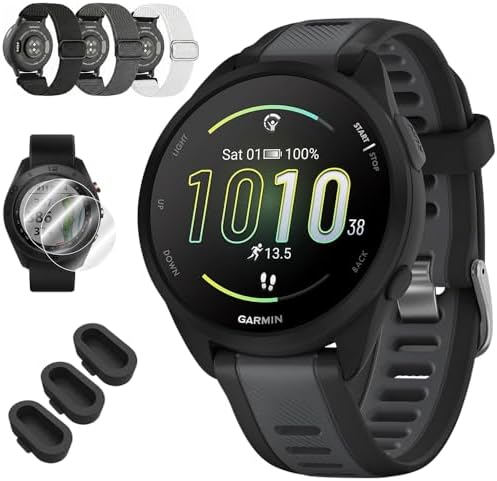
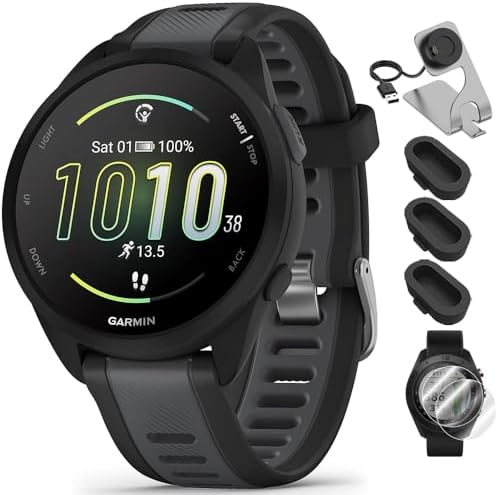
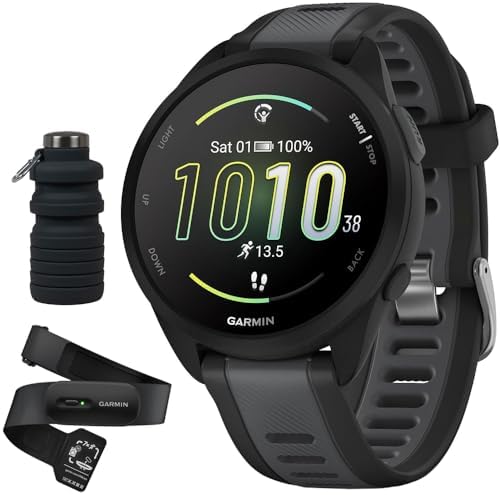
For anyone who checks split accuracy after a race and finds the numbers wrong, the more capable antenna is the upgrade that matters. The everyday edition of the more compact model, the Garmin Forerunner 165 in black, gives a clear picture of what the lighter, brighter option delivers on standard routes, while the Forerunner 165 range keeps that same compact, display-first formula across its variants.
Training Analytics, Recovery and Coaching
Both watches are far more capable than the average runner will exhaust. VO2 max estimates, training effect, recovery time and suggested workouts appear on the 165, giving a structured starting point for someone building a base or preparing for a first half marathon.
The 255 extends that framework with a race widget that projects finish times from current fitness, plus daily suggested workouts that account for race goals. For runners working to a schedule, that is the difference between a watch that records training and one that helps plan it.
One clarification keeps expectations honest: neither device includes the training readiness score. Garmin reserves that metric for the Forerunner 265 and above, and community discussion among Forerunner 165 owners confirms the 165 lacks it while the 255 also sits outside that feature tier. Buyers who want readiness scoring need to move up the range, not sideways between these two.
Who Gets the Most From Each Analytics Set
The 165 fits a runner who wants guidance without a dashboard. The essentials are visible, the app workflow is simple, and the screen makes the data approachable.
The 255 fits a runner with a plan on the wall: interval sessions, tempo blocks, a target race and a spreadsheet. Its extra metrics only pay off when there is a training structure to plug them into.
Making the Purchase Decision
The decision comes down to three questions, answered in order.
- Do you race longer than a half marathon? If yes, the battery and multi-band accuracy of the 255 justify themselves quickly.
- Is the watch your main display for data? If a bright, colorful screen keeps you motivated and you glance at it constantly, the 165 is the more enjoyable daily device.
- Do you run in cities with tall buildings or forests with heavy canopy? If GPS traces have disappointed you before, dual-frequency positioning is worth the step up.
Budget and wrist size usually settle the rest. Slimmer wrists and a smaller frame favor the 165; larger wrists and triathlon modes favor the 255. Both remain strong value, and neither is a wrong choice so much as a choice about emphasis.
Supporting that view, the Garmin Forerunner 255 in Slate Gray shows how the endurance tier is executed in practice: understated on the wrist, tireless on the long run, and built to keep recording when the miles do not stop.
The Broader Picture for Runners
Running watches rarely fail because they lack sensors; they disappoint because they do not match a runner's habits. Someone training for a first 10K in a flat park needs a clear display, reliable pace and simple recovery cues. Someone chasing a personal best in a crowded marathon needs a signal that survives skyscrapers and enough battery to cover the warm-up, race and cool-down without worry.
That is the line that separates these two Garmin models. The 165 brings the brightness and clarity of modern smartwatch displays to an accessible running tool. The 255 brings patience and precision, tuned for distance. One is the natural starting point that does not feel like a compromise; the other is the long-run partner that keeps pace with a training plan rather than just recording it. Choosing between them is less about features and more about which kind of runner is looking at their wrist.
 Just Pick Your Favorite Stylish Watch online
















Item Reviews